Oct 14, 2026
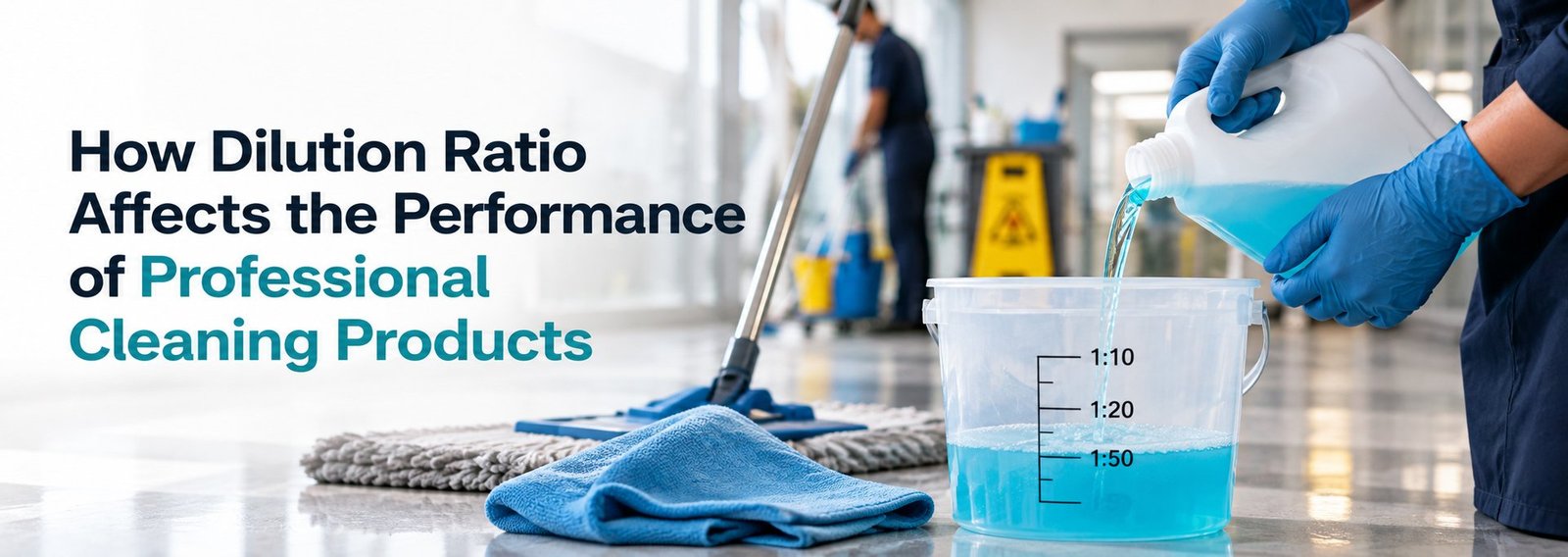
How Dilution Ratio Affects the Performance of Professional Cleaning Products
Professional cleaning depends on more than choosing a good cleaning product. The way that product is prepared and used can also influence its performance. One important factor is the dilution ratio, which determines how much cleaning product is mixed with water before application.
Using the recommended dilution ratio helps a cleaning solution perform as intended while supporting effective cleaning, consistent results, and efficient product usage. A solution that is too concentrated or too diluted may not provide the expected results for a particular cleaning task.
What Is a Dilution Ratio?
A dilution ratio describes the proportion of cleaning product to water used when preparing a solution.
For example, a 1:10 dilution generally means one part of cleaning product is mixed with ten parts of water.
The appropriate ratio depends on the product formulation, cleaning requirement, surface, level of contamination, and manufacturer’s instructions.
Dilution is therefore not simply about adding water to a product. It is about preparing the solution at a concentration suitable for its intended application.
Why Does Dilution Ratio Matter?
Professional cleaning products are formulated with specific concentrations of active ingredients. Changing the amount of water changes the concentration of those ingredients in the final solution.
This can influence:
- Cleaning effectiveness
- Product consumption
- Cost per cleaning task
- Residue formation
- Surface compatibility
- Consistency of cleaning results
Following the recommended dilution ratio helps cleaning teams use the product according to its intended formulation.
What Happens When a Cleaning Product Is Too Diluted?
Adding more water than recommended reduces the concentration of the cleaning solution.
Depending on the product and cleaning task, excessive dilution may result in:
Reduced Cleaning Effectiveness
A weaker solution may not provide sufficient cleaning action for dirt, grease, stains, or other contaminants.
More Product Consumption
If a diluted solution does not clean effectively, workers may need to repeat the cleaning process or use larger quantities of solution.
Inconsistent Results
Different employees may prepare different concentrations if there is no clear dilution procedure, leading to inconsistent cleaning across a facility.
What Happens When a Cleaning Product Is Too Concentrated?
Using less water than recommended creates a stronger solution.
A higher concentration does not automatically mean better cleaning. It may lead to:
- Unnecessary product consumption
- Higher cleaning costs
- Increased residue
- Difficult rinsing
- Potential surface compatibility concerns
For this reason, increasing the product concentration should not be treated as a shortcut for improving cleaning performance.
How Dilution Affects Cleaning Efficiency
A suitable dilution ratio creates a balance between product concentration and cleaning requirements.
Consider a commercial facility where large floor areas need to be cleaned regularly. If the cleaning solution is prepared according to the manufacturer’s recommendation, the team can maintain a consistent concentration across different cleaning cycles.
This can make product usage easier to monitor and help standardise cleaning procedures.
The same principle applies to other cleaning tasks, although the appropriate ratio may differ according to the product and application.
Dilution and Different Cleaning Applications
Different cleaning products serve different purposes. A surface cleaner, floor cleaner, toilet cleaner, or phenyl may have different preparation and application requirements.
Goodwill FMCG India Pvt. Ltd. offers cleaning and hygiene products including surface cleaners, floor cleaners, toilet cleaners, hand wash, and phenyl for different cleaning requirements.
Because formulations and intended uses vary, the dilution instructions for one product should not automatically be applied to another.
How to Maintain Consistent Dilution
Professional facilities can improve consistency by creating a simple dilution process.
1. Read the Product Instructions
Always begin with the manufacturer’s recommended dilution instructions.
2. Use Accurate Measurements
Avoid estimating quantities by eye when precise dilution is required. Measuring the product and water helps maintain consistency.
3. Use Suitable Containers
Clearly identified measuring containers can make preparation easier and reduce mistakes.
4. Train Cleaning Staff
Employees should understand what the dilution ratio means and why following it matters.
5. Standardise the Process
A documented procedure can help different employees prepare the same solution consistently.
Common Dilution Mistakes
Some common mistakes include:
- Adding too much water to make the product last longer
- Assuming a stronger solution always cleans better
- Guessing the quantity instead of measuring
- Using the same dilution ratio for different products
- Ignoring manufacturer instructions
- Failing to train new cleaning staff
These mistakes can affect both cleaning performance and product efficiency.
A Practical Example
Imagine a facility that prepares a floor cleaning solution every morning. If different employees use different quantities of product and water, the concentration can vary from one day to another.
Some areas may receive a weaker solution, while others may receive an unnecessarily concentrated mixture.
Introducing a standard dilution procedure with clear measurements can help the facility maintain greater consistency while making product consumption easier to track.
The objective is not to use more cleaning product. It is to use the right concentration for the intended cleaning task.
Best Practices for Diluting Cleaning Products
For reliable results, cleaning teams should:
1. Follow the manufacturer’s dilution instructions. 2. Measure both product and water accurately. 3. Use clean and suitable containers. 4. Prepare solutions according to the intended application. 5. Avoid assuming that higher concentration means better performance. 6. Train employees on correct preparation methods. 7. Monitor product consumption and cleaning results. 8. Review procedures when cleaning requirements change.
These practices can help organisations improve consistency without unnecessarily increasing product usage.
How Goodwill FMCG Supports Cleaning Requirements
Goodwill FMCG India Pvt. Ltd. provides cleaning and hygiene products designed for different residential, commercial, and industrial cleaning requirements. Its product range includes surface cleaners, floor cleaners, toilet cleaners, hand wash, and phenyl.
Selecting an appropriate product is only one part of an effective cleaning programme. Correct preparation and application also matter. Following product specific instructions helps users achieve the intended balance between cleaning performance and efficient product use.
Quick Checklist
Before preparing a professional cleaning solution, check:
- What product is being used?
- What is the recommended dilution ratio?
- What surface or area will be cleaned?
- Are the product and water being measured accurately?
- Are employees following the same preparation method?
- Is the solution being used for its intended application?
- Are cleaning results consistent?
- Is product consumption being monitored?
Frequently Asked Questions
1. What is a dilution ratio in cleaning?
A dilution ratio specifies the proportion of cleaning product and water used to prepare a cleaning solution.
2. Why is the correct dilution ratio important?
It helps the cleaning product perform according to its intended formulation while supporting consistent and efficient use.
3. Does more cleaning product always mean better cleaning?
No. A stronger solution is not automatically more effective and may increase product consumption or leave unnecessary residue.
4. What happens when a cleaning solution is too diluted?
It may have insufficient cleaning action for the intended task and could require additional cleaning or repeated application.
5. Can different cleaning products have different dilution ratios?
Yes. Dilution requirements depend on the formulation and intended application of each product.
6. How should cleaning products be measured?
Use suitable measuring equipment and follow the manufacturer’s recommended preparation instructions.
7. Does dilution affect cleaning costs?
Yes. Incorrect dilution can increase product consumption, rework, or cleaning time, affecting overall operating costs.
8. Is dilution important for commercial cleaning?
Yes. Consistent preparation is particularly useful in commercial and industrial facilities where cleaning is performed regularly across larger areas.
9. Should cleaning staff be trained on dilution?
Yes. Training can help employees understand measurements, preparation procedures, and the importance of following product instructions.
10. Where can I find the correct dilution ratio?
The manufacturer’s product instructions should be the primary reference for the recommended dilution and application method.
Conclusion
Dilution ratio plays an important role in the performance and efficient use of professional cleaning products. Using too much water can reduce cleaning effectiveness, while excessive product concentration can increase consumption and create unnecessary cleaning challenges.
The best approach is to follow the recommended dilution ratio, measure accurately, and maintain a consistent preparation process across cleaning operations.
For businesses looking for reliable cleaning and hygiene product solutions, Goodwill FMCG India Pvt. Ltd. offers a range of products for different cleaning requirements.
If you need help choosing suitable cleaning products for your residential, commercial, or industrial requirements, connect with Goodwill FMCG India Pvt. Ltd. for the right cleaning and hygiene product solutions.