Sep 15, 2026
How Incident Response Helps Businesses Minimize the Impact of Cybersecurity Threats
What is an incident response?
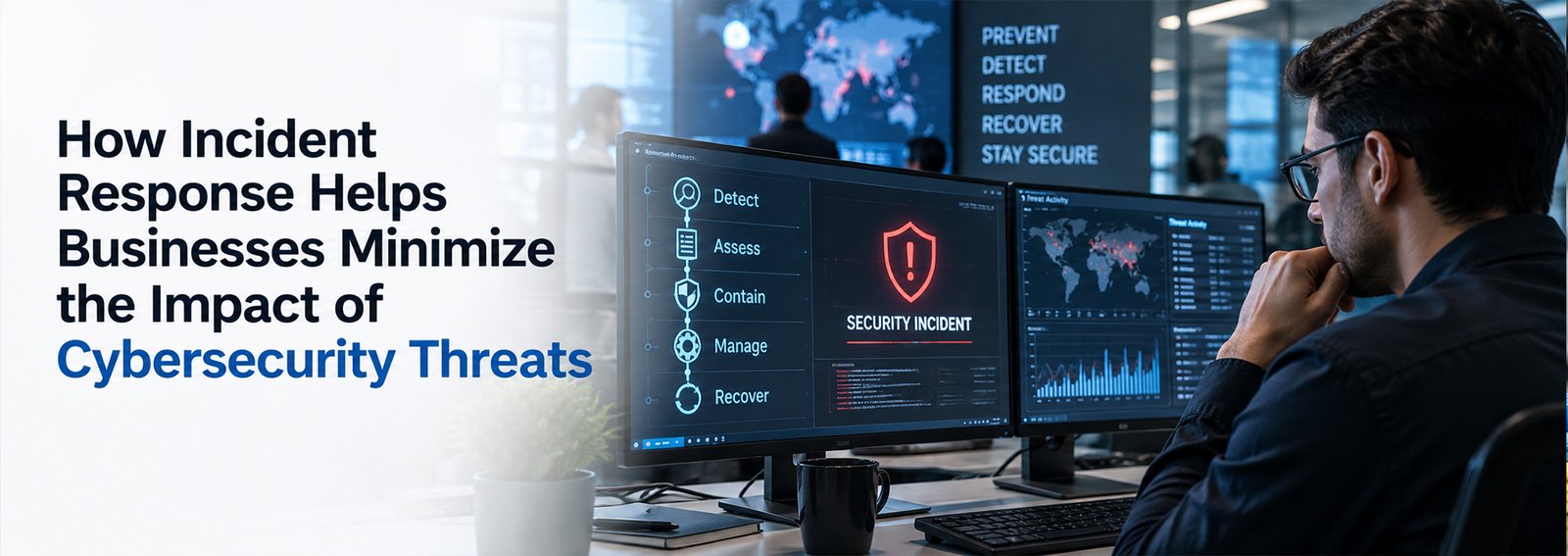
Incident response is a structured approach businesses use to detect, assess, contain, manage, and recover from cybersecurity incidents. A well planned response helps organizations limit disruption, protect important information, restore affected systems, and understand what caused the incident so similar problems can be addressed in the future.
A cyber incident can affect more than technical systems. It can interrupt operations, expose sensitive information, affect customer trust, and create compliance concerns. Having a defined response process allows businesses to act systematically instead of making decisions under pressure.
Why Incident Response Matters for Businesses
Cybersecurity incidents can take different forms. A business may experience unauthorized access, malware activity, suspicious network behavior, compromised credentials, or an attempt to access protected information.
The impact often depends not only on how the threat entered the organization, but also on how quickly and effectively the organization responds.
Without a structured approach, teams may lose valuable time trying to determine what happened. They may also overlook affected systems, delay containment, or restore systems without addressing the underlying problem.
An effective incident response process helps businesses:
- Identify suspicious activity more efficiently
- Limit the spread of a security incident
- Protect critical business information
- Reduce operational disruption
- Support faster recovery
- Establish clearer responsibilities during an incident
- Identify lessons that can strengthen future security
Key Stages of an Incident Response Process
Incident response is not limited to what happens after a security problem is discovered. It involves several connected stages.
1. Preparation
Businesses should establish procedures before an incident occurs. This includes defining responsibilities, communication processes, critical systems, escalation procedures, and response priorities.
Preparation helps teams avoid confusion when immediate action is required.
2. Detection and Assessment
The next step is identifying suspicious activity and determining whether it represents a genuine security incident.
Teams may review alerts, unusual system behavior, access activity, network events, or other indicators. The objective is to understand the nature and potential scope of the incident.
3. Containment
Once an incident is confirmed, the priority is to prevent further damage.
Depending on the situation, containment may involve isolating affected systems, restricting access, or separating compromised resources from other parts of the business environment.
The right response depends on the nature of the incident and the systems involved.
4. Recovery
After the threat has been contained and affected systems have been assessed, the organization can begin restoring normal operations.
Recovery should be controlled rather than rushed. Businesses need to confirm that systems are safe to return to service and that appropriate security measures are in place.
5. Review and Improvement
An incident should not simply be considered finished once operations return to normal.
A post incident review can help identify what happened, how the organization responded, what worked, and where improvements are required.
These findings can contribute to stronger business cybersecurity practices in the future.
How Incident Response Reduces Business Impact
A structured incident response approach can reduce the consequences of a cybersecurity event in several ways.
Faster decision making
Clearly defined procedures help teams understand what actions should be taken and who should be involved.
Better threat containment
Quick identification and containment can help prevent a localized security problem from affecting additional systems.
Reduced operational disruption
When recovery responsibilities and priorities are established in advance, businesses can work toward restoring important operations more efficiently.
Better data protection
Incident response supports efforts to identify potentially affected information and take appropriate steps to protect business data.
Stronger future preparedness
Every security incident can provide useful information. Reviewing incidents can help organizations improve procedures, security controls, employee practices, and monitoring.
Common Mistakes During a Cybersecurity Incident
Even businesses with security measures in place can make mistakes during an incident.
Some common problems include:
- Delaying investigation because the warning appears minor
- Not clearly assigning response responsibilities
- Failing to document important incident details
- Restoring affected systems before understanding the cause
- Focusing only on immediate recovery without reviewing what happened
- Treating every incident in exactly the same way
A response process should be practical enough for teams to follow during a stressful situation.
Best Practices for Effective Incident Response
Businesses can strengthen their incident response readiness by:
- Defining response responsibilities so teams know who handles specific actions.
- Establishing escalation procedures for incidents requiring specialized support.
- Maintaining clear documentation of incidents, actions, and outcomes.
- Prioritizing critical systems so recovery efforts focus on essential operations.
- Reviewing incidents after resolution to identify weaknesses and improvements.
- Connecting response with broader cybersecurity measures such as network security, compliance management, and proactive threat monitoring.
Incident response works best as part of a broader security strategy rather than as an isolated activity.
A Practical Example
Consider a business that notices unusual activity involving one of its systems. Without a defined response process, employees may spend time determining who should investigate the issue while the activity continues.
With a structured incident response process, the organization can identify the incident, assess the affected system, contain the issue, investigate its scope, and begin recovery according to established procedures.
Once the immediate issue is resolved, the business can review how the incident occurred and determine whether additional security measures are needed.
The goal is not simply to respond to one incident. It is to become better prepared for the next one.
How Goodwill B2B B2C Service Industries Supports Business Security
Goodwill B2B B2C Service Industries India Pvt. Ltd. provides cybersecurity and risk management services designed to help organizations protect their operations and reduce security risks.
Its comprehensive cybersecurity solutions include vulnerability assessment, network security, compliance management, incident response, and security awareness programs. The company also highlights proactive threat monitoring, data protection, regulatory compliance, customized security solutions, and responsive technical support.
This broader approach is important because incident response is most effective when it works alongside other security measures. Businesses need both preparedness and the ability to respond when threats emerge.
Quick Incident Response Checklist
Businesses can use this checklist to review their preparedness:
- Is there a defined incident response process?
- Are response responsibilities clearly assigned?
- Are important systems and information identified?
- Is there a clear escalation procedure?
- Can suspicious activity be investigated promptly?
- Are affected systems isolated when necessary?
- Are incidents documented during the response?
- Is recovery performed in a controlled manner?
- Are incidents reviewed after resolution?
- Are lessons from previous incidents used to improve security?
Frequently Asked Questions
1. What is incident response in cybersecurity?
Incident response is the structured process of identifying, managing, containing, and recovering from cybersecurity incidents.
2. Why is incident response important for businesses?
It helps businesses respond systematically to security incidents, reduce disruption, protect information, and support recovery.
3. What are common cybersecurity incidents?
Examples include unauthorized access, malware activity, compromised credentials, suspicious network activity, and attempts to access protected information.
4. What is the first step in incident response?
Preparation is an important starting point because businesses need defined responsibilities and procedures before an incident occurs.
5. What does containment mean in incident response?
Containment involves taking appropriate steps to prevent a security incident from spreading or causing additional damage.
6. Does incident response only happen after an attack?
No. Effective incident response includes preparation, detection, assessment, containment, recovery, and post incident review.
7. How does incident response support data protection?
It helps businesses identify potentially affected systems or information and take appropriate steps to limit further exposure.
8. Can incident response reduce business downtime?
A structured process can support faster decision making, containment, and recovery, which may help reduce operational disruption.
9. Why should businesses review incidents after recovery?
A post incident review can reveal weaknesses and provide lessons that help improve future cybersecurity measures.
10. Is incident response part of a broader cybersecurity strategy?
Yes. It can work alongside network security, vulnerability assessment, compliance management, security awareness, and proactive threat monitoring.
11. Does every cybersecurity incident require the same response?
No. The appropriate response depends on the type, severity, affected systems, and potential impact of the incident.
12. When should a business consider professional cybersecurity support?
Businesses may benefit from professional support when they need specialized expertise for threat monitoring, security assessment, incident response, compliance, or broader cybersecurity requirements.
Conclusion
Cybersecurity incidents can create operational, financial, data protection, and reputational challenges for businesses. While prevention remains important, organizations also need to be prepared for situations where a security incident occurs.
A structured incident response process gives businesses a clearer way to detect problems, contain threats, recover affected operations, and learn from security events. When combined with broader cybersecurity measures, it can strengthen an organization’s ability to manage threats and protect critical business operations.
For organizations looking for dependable cybersecurity solutions, Goodwill B2B B2C Service Industries provides incident response alongside vulnerability assessment, network security, compliance management, security awareness programs, and other cybersecurity and risk management services.