Sep 07, 2026
How Laboratory Turnaround Time Affects Diagnostic Service Efficiency
A diagnostic test is useful only when its result reaches the right person at the right time. When laboratory processes take longer than expected, delays can affect clinical decisions, follow up, workplace health assessments, and the overall patient experience. This makes laboratory turnaround time an important part of efficient diagnostic service delivery.
What Is Laboratory Turnaround Time?
Laboratory turnaround time is the period between the defined start of a laboratory testing process and the availability of the completed result. It reflects how efficiently samples move through registration, testing, verification, reporting, and result delivery. Good turnaround time helps healthcare providers receive dependable information without unnecessary delays.
Why Laboratory Turnaround Time Matters
Laboratory testing involves more than simply analysing a sample. Several connected activities need to work properly for a result to be completed and delivered.
A delay at any stage can affect the overall reporting timeline. For example, a sample may reach the laboratory quickly but remain pending because of workload, processing requirements, verification, or reporting procedures.
Efficient turnaround time therefore depends on the entire laboratory workflow rather than one individual step.
For healthcare providers and patients, timely results can support:
- Faster clinical decision making
- Better coordination between healthcare professionals
- More efficient follow up
- Improved patient experience
- Better management of routine testing
- Smoother occupational health assessments
- More predictable laboratory operations
Goodwill Biopharma Healthcare provides pathology lab diagnostics using modern systems for areas including blood, biochemical, serology, microbiology, and hormonal assessments, with an emphasis on quality and timely service.
What Factors Influence Laboratory Turnaround Time?
Several operational factors can influence how quickly a diagnostic result becomes available.
1. Sample Registration and Identification
The process begins when a sample is received and correctly registered. Accurate patient information, test details, and sample identification are essential.
If registration is incomplete or requires clarification, processing may be delayed before testing even begins.
2. Sample Handling and Preparation
Different diagnostic tests may require different preparation and handling procedures. Samples must be processed according to the requirements of the specific test.
Proper handling helps laboratories avoid unnecessary repeat work and supports a smoother testing workflow.
3. Laboratory Workload
The number and type of samples being processed can influence turnaround time. A laboratory managing high volumes needs an organised workflow that allows routine and specialised tests to move efficiently through the appropriate stages.
Workload management is particularly important when several testing categories are handled within the same facility.
4. Testing Requirements
Not every laboratory test follows the same process.
Routine investigations may move through a relatively straightforward workflow, while specialised testing can require additional processing or verification.
Understanding these differences helps laboratories establish realistic turnaround expectations instead of applying the same timeline to every test.
5. Result Verification and Reporting
Testing does not necessarily end when an instrument produces a result. Results may require review and verification before they are released.
This step is important because speed should never replace accuracy. A fast result that has not been appropriately reviewed does not provide the same value as a dependable result delivered through a controlled process.
How an Efficient Laboratory Workflow Supports Timely Results
A well organised laboratory workflow can be viewed as a connected sequence:
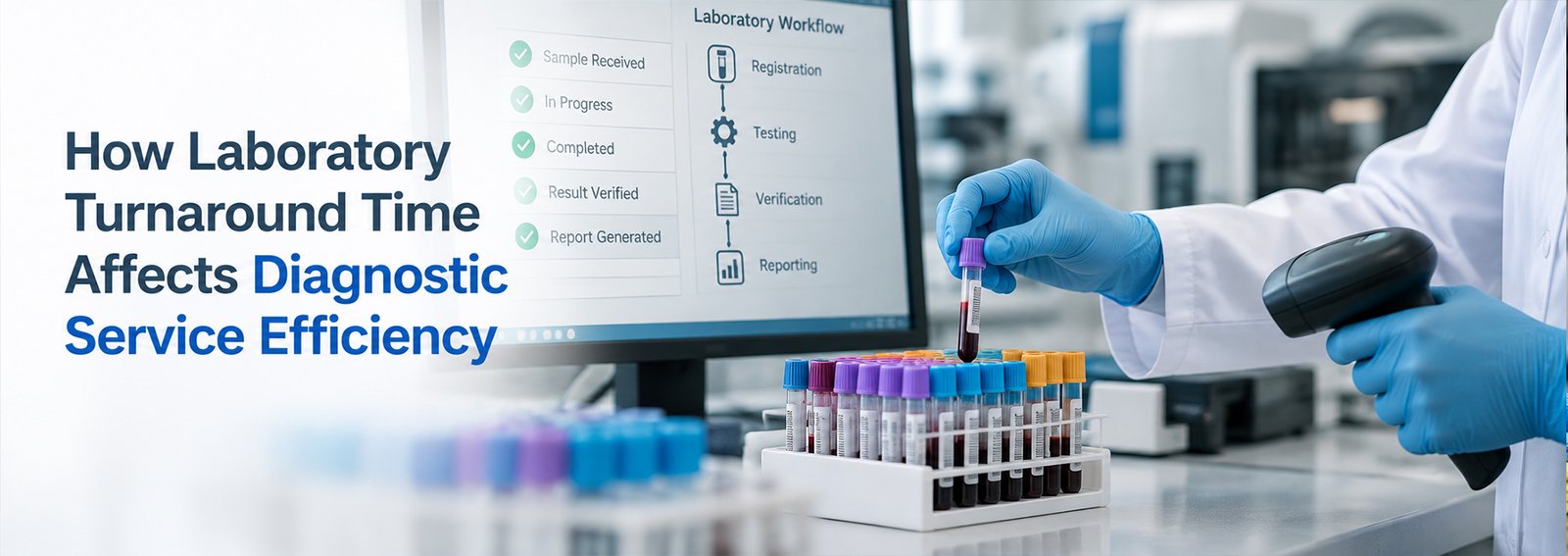
Sample received → Registration → Preparation → Testing → Result review → Reporting → Result delivery
Each stage contributes to the final turnaround time.
If one stage becomes a bottleneck, the effect can extend to the remaining stages. This is why laboratories need to look at the complete workflow instead of focusing only on testing speed.
For example, improving instrument capacity may not solve delays if registration or result verification is creating the actual bottleneck.
Benefits of Improving Laboratory Turnaround Time
Improving turnaround time can provide operational and service related benefits when it is done without compromising testing quality.
Better coordination
Timely results allow healthcare professionals to coordinate the next stage of care more efficiently.
Improved patient experience
Patients often want clarity about when their reports will be available. Predictable reporting can reduce unnecessary uncertainty and repeated follow up.
More efficient laboratory operations
A structured workflow helps laboratories identify bottlenecks and allocate resources more effectively.
Smoother occupational health services
Industrial health programs may involve pre employment and periodic health assessments. Efficient laboratory reporting can support the broader workflow of these programs. Goodwill Biopharma Healthcare specifically provides occupational health programs tailored to industry requirements.
A Practical Example
Consider an employee undergoing a routine health assessment that includes blood testing.
The sample is collected and reaches the laboratory, but the reporting process is delayed because the sample registration details require clarification. Even though the actual testing may be completed efficiently, the overall result delivery is affected.
Now consider the same workflow with accurate registration, organised sample movement, appropriate testing, timely verification, and efficient report delivery.
The difference is not necessarily the testing technology. It is the coordination of the entire process.
This illustrates why laboratory turnaround time depends on workflow efficiency as much as individual testing speed.
Best Practices for Better Laboratory Turnaround Time
Laboratories can improve efficiency by focusing on the complete testing workflow.
Standardise routine processes
Clear procedures for registration, sample movement, testing, verification, and reporting can reduce avoidable delays.
Monitor workflow bottlenecks
If delays occur repeatedly at the same stage, identifying the cause is more useful than simply asking staff to work faster.
Match resources with workload
Staff, equipment, and testing capacity should be planned according to expected laboratory requirements.
Maintain clear communication
Healthcare teams and patients should receive realistic information about expected reporting timelines.
Protect quality while improving speed
Turnaround time should be improved through better processes, not by removing essential quality checks.
Review performance regularly
Laboratories can assess where delays occur and use those observations to improve workflow over time.
Common Mistakes That Can Delay Laboratory Reporting
Some delays are caused by avoidable process problems.
Common examples include:
- Incomplete patient or test information
- Poor coordination between workflow stages
- Unclear responsibility for pending samples
- Failure to identify recurring bottlenecks
- Overlooking workload fluctuations
- Rushing verification to meet time targets
- Giving unrealistic reporting expectations
- Focusing on one stage instead of the complete process
The goal should not be the fastest possible report at any cost. The goal is a timely and dependable diagnostic result.
How Goodwill Biopharma Healthcare Supports Diagnostic Service Delivery
Goodwill Biopharma Healthcare India Pvt. Ltd. provides pathology lab services alongside industrial health checkups, nursing support, X Ray, ECG, and other healthcare services. Its pathology capabilities include blood, biochemical, serology, microbiology, and hormonal assessments using modern systems. The company also highlights quality, safety, customer satisfaction, and timely service as part of its healthcare approach.
This broader service capability is important because diagnostic efficiency is not only about producing a laboratory result. It is about supporting a dependable healthcare workflow from testing to service delivery.
Quick Checklist for Efficient Laboratory Turnaround
Before evaluating laboratory turnaround time, consider:
- Is sample registration accurate?
- Are samples handled through a defined process?
- Are workflow bottlenecks identified?
- Is laboratory workload monitored?
- Are specialised tests handled according to their requirements?
- Are results appropriately reviewed before release?
- Are reporting timelines communicated clearly?
- Are recurring delays analysed?
- Is service speed being balanced with testing quality?
- Is the overall workflow reviewed regularly?
Frequently Asked Questions
1. What is laboratory turnaround time?
Laboratory turnaround time refers to the time taken for a defined laboratory testing process to reach completed result reporting.
2. Why is laboratory turnaround time important?
It helps determine how efficiently diagnostic information moves from sample processing to result delivery and can influence healthcare workflow and patient experience.
3. What can cause delays in laboratory reporting?
Delays can result from registration issues, sample handling, workload, specialised testing requirements, workflow bottlenecks, or result verification.
4. Does faster laboratory reporting always mean better service?
No. Speed should be balanced with accurate testing, appropriate verification, and dependable reporting.
5. How can laboratories improve turnaround time?
Laboratories can improve turnaround time through organised workflows, standardised processes, workload planning, bottleneck identification, and regular performance review.
6. Do all laboratory tests have the same turnaround time?
No. Turnaround time can vary depending on the type of test, sample requirements, processing steps, and reporting procedures.
7. How does workload affect laboratory turnaround time?
Higher workloads can increase waiting time if laboratory resources and processes are not appropriately managed.
8. What role does sample registration play in turnaround time?
Accurate registration helps samples enter the correct workflow without unnecessary clarification or processing delays.
9. Why is result verification important?
Verification helps ensure that results are appropriately reviewed before they are released, supporting dependable diagnostic reporting.
10. Can turnaround time affect patient experience?
Yes. Predictable and timely reporting can make the diagnostic process more convenient and reduce uncertainty for patients.
11. Is turnaround time important for occupational health programs?
Yes. Timely diagnostic results can support the efficient completion of pre employment and periodic health assessments.
12. What should laboratories prioritise when improving turnaround time?
Laboratories should prioritise a balance of timely service, accurate testing, controlled processes, and dependable result reporting.
Conclusion
Laboratory turnaround time is an important part of diagnostic service efficiency because every stage of the testing workflow contributes to when a result becomes available. Improving registration, sample movement, testing, verification, reporting, and communication can help reduce avoidable delays while maintaining dependable service.
For laboratories and healthcare providers, the objective should not simply be to produce reports faster. It should be to create a consistent, organised, and quality focused diagnostic workflow that delivers reliable information when it is needed.
Goodwill Biopharma Healthcare combines pathology lab diagnostics with industrial health checkups and other healthcare services, with a stated focus on quality and timely service. For organisations seeking dependable pathology lab services and healthcare support, a well managed diagnostic workflow can make an important difference to overall service efficiency.
For pathology testing, industrial health assessments, and related healthcare services, Goodwill Biopharma Healthcare can support organisations with a range of diagnostic and healthcare requirements through its integrated service offering.