Jul 15, 2026
How Zero Trust Security Reshapes Cybersecurity for Modern Business Environments
Businesses today operate in an increasingly connected digital ecosystem where employees, customers, vendors, and business applications interact across multiple devices and locations. Cloud computing, hybrid work environments, mobile access, and digital collaboration have transformed the way organisations function. While these advancements improve efficiency and flexibility, they also expand the number of entry points that cybercriminals can target.
Traditional cybersecurity strategies were designed around the idea of protecting a defined network perimeter. Once users gained access to the internal network, they were often considered trustworthy. However, this approach is becoming less effective as modern businesses rely on distributed workforces, cloud platforms, and interconnected digital services.
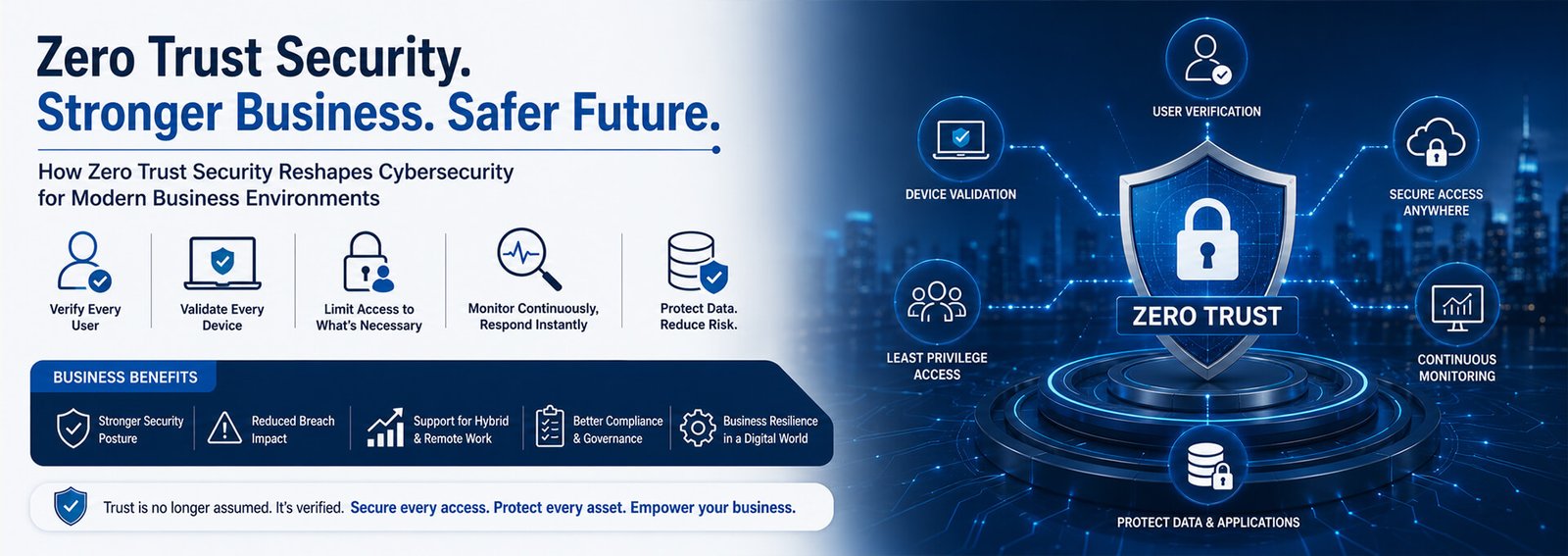
Zero Trust Security represents a significant shift in cybersecurity thinking. Instead of assuming trust based on location or network access, it requires every user, device, and application to verify its identity before accessing organisational resources. This security model helps organisations reduce cyber risks while adapting to the demands of today’s digital business environment.
Understanding the Zero Trust Security Model
Zero Trust Security is a cybersecurity framework based on a simple principle: no access request should be trusted automatically. Every request to access systems, applications, or sensitive information must first be verified according to predefined security policies.
Unlike conventional security models that focus primarily on defending the network boundary, Zero Trust protects individual resources by validating every interaction throughout the user session.
Core principles of Zero Trust include:
- Identity verification for every user
- Controlled access based on job responsibilities
- Continuous monitoring of user activity
- Device validation before granting access
- Protection of sensitive business data
These principles help organisations maintain tighter control over digital resources while reducing opportunities for unauthorised access.
How Digital Transformation Has Changed Cybersecurity Requirements
Business technology has evolved far beyond traditional office networks. Employees now work from multiple locations, access cloud-based applications, and collaborate using digital platforms that operate outside conventional network boundaries.
This evolution has introduced several new cybersecurity challenges:
- Remote workforce connectivity
- Cloud-based business applications
- Personal and company-owned devices
- Third-party software integrations
- Increasingly sophisticated cyberattacks
Modern organisations require security strategies that can protect information regardless of where users or devices are located.
How Zero Trust Changes Business Cybersecurity
Zero Trust Security reshapes cybersecurity by replacing assumptions with continuous verification. Instead of granting broad access after a single login, every interaction is evaluated according to current security conditions.
This approach changes cybersecurity in several important ways:
Identity Becomes the Primary Security Layer
Access decisions are based on verified identities rather than network location. Employees, contractors, and external partners must authenticate themselves before accessing organisational resources.
Every Device Must Meet Security Standards
A verified user alone is not enough. Devices attempting to connect must also satisfy security requirements such as updated software, secure configurations, and compliance with organisational policies.
Access Is Limited to Business Requirements
Users receive only the permissions necessary to perform their assigned responsibilities. Restricting unnecessary access reduces the potential impact of compromised accounts.
Security Verification Continues After Login
Authentication is not treated as a one-time event. User behaviour, device status, and access patterns continue to be monitored throughout each session to identify unusual or potentially risky activity.
Supporting Secure Remote and Hybrid Work
Hybrid working models have become common across many industries. Employees frequently connect to business systems from home offices, client locations, and while travelling.
Zero Trust Security helps organisations maintain secure access by:
- Verifying every login request
- Applying consistent security policies across locations
- Protecting cloud applications
- Monitoring remote sessions continuously
This allows organisations to support flexible working arrangements without reducing cybersecurity standards.
Reducing Business Risks Through Controlled Access
Cybersecurity incidents are not always caused by external attackers. Compromised credentials, excessive user permissions, and accidental employee actions can also expose organisations to significant risks.
Zero Trust reduces these risks through:
- Role-based access controls
- Multi-factor authentication
- Continuous identity validation
- Network segmentation
- Real-time monitoring
By controlling who can access information and under what conditions, organisations strengthen protection for their critical business assets.
Protecting Sensitive Business Information
Modern organisations manage large volumes of confidential information, including financial records, customer data, intellectual property, and operational documents.
Zero Trust Security helps protect these assets by ensuring that access is granted only after multiple layers of verification.
This approach improves:
- Data confidentiality
- Access control
- Information security
- Regulatory compliance
- Overall organisational resilience
Protecting sensitive information has become essential not only for operational continuity but also for maintaining customer trust.
Supporting Compliance and Security Governance
Many industries operate under regulations that require organisations to demonstrate responsible management of digital information. Security frameworks such as Zero Trust help businesses strengthen governance while supporting compliance with evolving cybersecurity standards.
Implementing structured access controls, authentication procedures, and monitoring systems enables organisations to improve accountability across their digital operations.
Strong governance also provides management teams with greater visibility into potential risks and supports informed cybersecurity decision-making.
Preparing for the Future of Business Security
Cybersecurity continues to evolve alongside technological innovation. As artificial intelligence, cloud computing, automation, and connected business ecosystems become more common, organisations need security models capable of adapting to these changes.
Zero Trust Security provides a flexible framework that supports long-term cybersecurity strategies by continuously evaluating trust rather than assuming it.
Businesses adopting this approach are better positioned to manage emerging cyber risks while maintaining secure digital operations.
Supporting Modern Cybersecurity and Risk Management
Developing an effective cybersecurity strategy requires more than implementing security software. It involves establishing policies, managing access, monitoring systems, and continuously improving organisational resilience.
Goodwill B2B B2C Service Industries India Pvt. Ltd. provides cybersecurity and risk management solutions that help organisations strengthen digital security, manage evolving cyber risks, and improve business resilience. By adopting structured cybersecurity practices and modern security frameworks, businesses can better protect their operations in an increasingly connected world.
Conclusion
Cybersecurity can no longer rely on assumptions that users or devices inside a network are automatically trustworthy. As business environments become more digital, distributed, and interconnected, organisations require security strategies that continuously verify every access request.
Zero Trust Security offers a practical framework for addressing these challenges through identity verification, controlled access, continuous monitoring, and proactive risk management. By embracing this approach, organisations can strengthen data protection, improve operational resilience, and build a cybersecurity strategy capable of supporting long-term business growth in the digital age.